English
 Español
 Português
 русский
 français
 日本語
 Deutsch
 Tiếng Việt
 Italiano
 Nederlands
 ไทย
 Polski
 한국어
 Svenska
 magyar
 Malay
 বাংলা
 Dansk
 Suomi
 Pilipino
 Gaeilge
 عربى
 norsk
 اردو
 čeština
 Ελληνικά
 Українська
 فارسی
 தமிழ்
 తెలుగు
 नेपाली
 Burmese
 български
 ລາວ
 Latine
 Қазақ
 Azərbaycan
 slovenský
 Македонски
 Lietuvos
 Eesti Keel
 Română
 Slovenski
 Српски
 Afrikaans
 Беларус
 Монгол хэл
 O'zbek
 Sundanese
 Javanese


Product Description
Introduction of Energy Storage Gas Detector
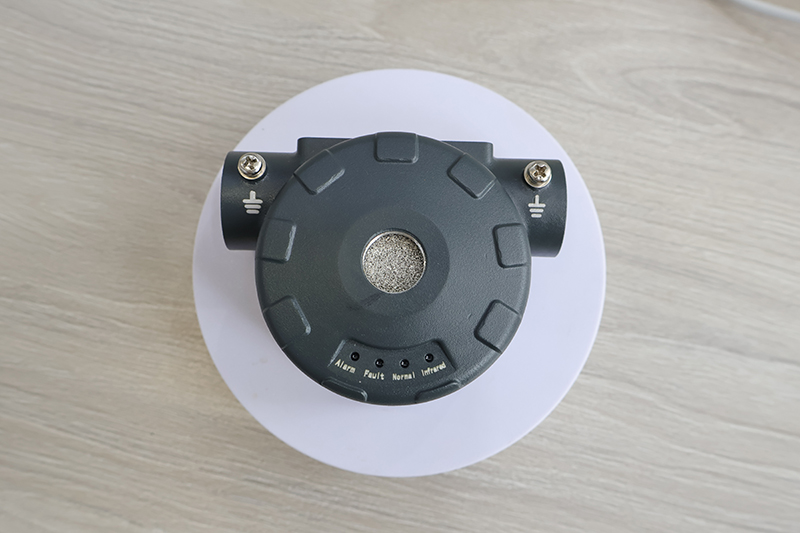
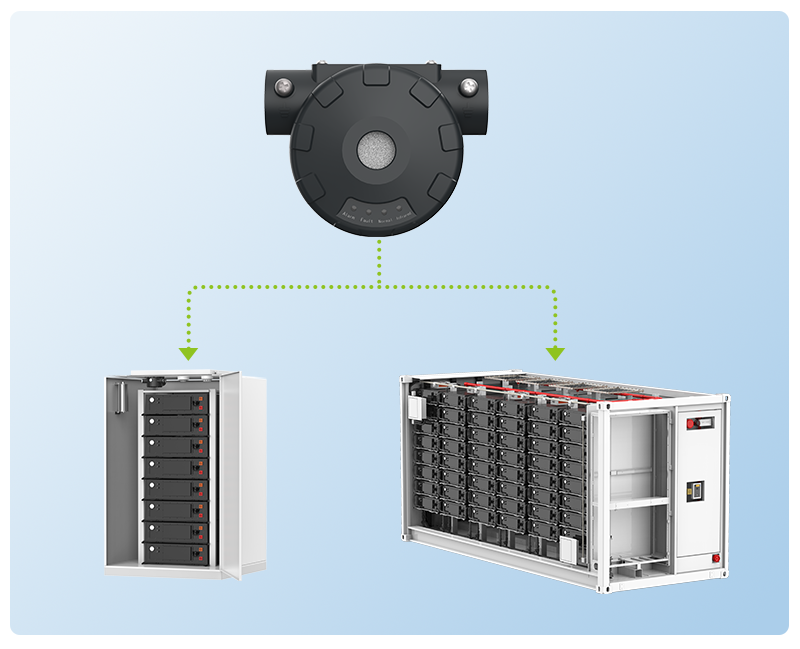
The CGT-H2100 gas detector is a professional hydrogen monitoring device tailored for energy storage scenarios, including energy storage containers, battery cabins and cabinets. Adopting thermal conduction sensing technology, it supports continuous real-time detection of hydrogen concentration, effectively monitoring battery thermal runaway risks to prevent safety accidents caused by hydrogen accumulation.
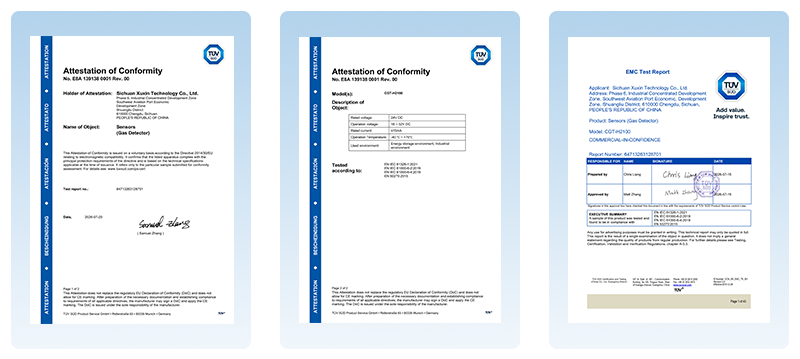
With robust explosion-proof performance, the detector features Ex db IIC T6 Gb and Ex tb IIIC T80℃ Db certification, adapting to Zone 1/2 gas and dust hazardous environments with T1-T6 temperature grades. It complies with mainstream international standards including CE, IECEx and ROHS, ensuring reliable operation in harsh industrial conditions.
Designed with modularization and miniaturization, the lightweight 420g aluminum alloy device boasts an IP66 waterproof and dustproof grade. It supports RS485 communication and dual relay alarm output, enabling seamless data interaction and rapid alarm signal feedback for energy storage systems.
Feature of Energy Storage Gas Detector
1) Ultra-long Service Life & Zero Maintenance: The sensor delivers a 15-year service life in normal environments with factory pre-calibration. It requires no regular calibration or daily maintenance, greatly reducing long-term operational costs.
2) High Detection Accuracy & Stability: It covers 0-100%LEL hydrogen detection range with 0.1%LEL high resolution and ±5%LEL detection error. Zero drift is controlled within 3%LEL, ensuring stable and precise monitoring for a long time.
3) Wide Environmental Adaptability: It works stably at -40℃ to +70℃ and 5%-95%RH humidity. The wide voltage input (18-32VDC) and low power consumption (≤1W) suit diverse energy storage operating environments.
4) Simple Installation & Flexible Networking: It supports two installation methods and hand-in-hand networking, with up to 32 devices connectable on a single RS485 bus. Adjustable 120Ω terminal resistance meets different on-site wiring needs.
Detail photos of Energy Storage Gas Detector
Product parameters of Energy Storage Gas Detector
| Type | Specific parameters |
| Appearance parameter | |
| Pigment | dark grey |
| Shell material | die-casting aluminium |
| Outline dimension | approximately 100 mm × 78 mm × 53 mm |
| Product weight | approximately 415 g |
| Function parameter | |
| Test gas | CO(carbon monoxide) |
| Sensor type | electrochemical sensor |
| Sample mode | natural diffusion |
| Detection range | (0~2000)×10-6 (volume fraction) |
| Operate mode | continuous monitoring |
| Alarm value setting range (Two-level alarm) |
The minimum alarm threshold for production output is set at 200×10-6 (volume fraction). The maximum alarm threshold for the outlet concentration is set at 500×10-6 (volume fraction). |
| Alarm error | ±50×10-6 (volume fraction) |
| Range indication deviation | allowable error: ±80×10-6 (volume fraction) |
| Alarming light visibility | > 5 m (in darkness) |
| Response time | ≤ 30s |
| Call time | ≤ 15s |
| Resolution ratio | 1×10⁻⁶ (volume fraction) |
| Zero drift range | ≤50×10-6 (volume fraction) |
| Sensor service life | normal monitoring environment for 15 years |
| Electrical parameters | |
| Working voltage | 18VDC-32VDC |
| Rated voltage | 24VDC |
| Power dissipation | ≤ 1W |
| Working current | ≤ 5 mA |
| Alarm current | ≤ 25mA |
| Maximum current | ≤ 25mA |
| Output signal | RS485 (optional) [The communication address defaults to 1 at factory; a built-in 120Ω matching resistor is not connected by default and can be enabled using a jumper cap] |
| Baud rate | 9600 bps |
| Dry contact 1 – Low alarm relay | Group 1: Contact capacity (resistance load): 1A @30VDC; 300 mA @ 125VAC. Factory default: Open during normal operation, close during alarms, open during power loss. |
| Dry contact 2 – High alarm relay | Group 1: Contact capacity (resistance load): 1A @30VDC; 300 mA @ 125VAC. Factory default: Open during normal operation, close during alarms, open during power loss. |
| Indicate way | |
| Pilot lamp | 3 LED status lights |
| State indication | 1. During normal operation: The green indicator light remains illuminated continuously |
| 2. In case of a malfunction: The yellow indicator light remains constantly illuminated. | |
| 3. Alarm indication: When the lower limit is exceeded, a red light flashes; when the upper limit is exceeded, the red light remains on continuously. | |
| 4. During the upgrade process: Red, yellow, and green lights will flash alternately. | |
| Upgrade and configuration parameters | Can be connected to a computer via the RS485 bus (optional) |
| Certification and protection level | |
| Attestation | ROHS, CE ,ATEx, IECEx |
| Protect grade | IP66 |
| Explosion-proof mark |
II2 G Ex db IIC T6 Gb II2 D Ex tb IIIC T80°C Db |
FAQ about Energy Storage Gas Detector
Q1: What is the default alarm threshold?
A1: Low alarm is 10%LEL and high alarm is 25%LEL, with red light flashing for low alarm and steady on for high alarm.
Q2: Does it need regular calibration?
A2: No. It is factory pre-calibrated and maintenance-free. Annual error testing is only required after the nominal service life.
Q3: Why does communication fail?
A3: It is mainly caused by wrong wiring, broken communication lines or duplicate device addresses. Check wiring consistency and reset unique addresses to fix.
Q4: What are the installation precautions?
A4: Install vertically downward, keep air intake unblocked, ensure reliable grounding (ground resistance <4Ω), and strictly prohibit live cover opening.
Q5: What causes detection deviation?
A5: Background gas changes, liquid thermal shock, volatile organic compound erosion or long-term helium exposure will lead to data deviation.