English
 Español
 Português
 русский
 français
 日本語
 Deutsch
 Tiếng Việt
 Italiano
 Nederlands
 ไทย
 Polski
 한국어
 Svenska
 magyar
 Malay
 বাংলা
 Dansk
 Suomi
 Pilipino
 Gaeilge
 عربى
 norsk
 اردو
 čeština
 Ελληνικά
 Українська
 فارسی
 தமிழ்
 తెలుగు
 नेपाली
 Burmese
 български
 ລາວ
 Latine
 Қазақ
 Azərbaycan
 slovenský
 Македонски
 Lietuvos
 Eesti Keel
 Română
 Slovenski
 Српски
 Afrikaans
 Беларус
 Монгол хэл
 O'zbek
 Sundanese
 Javanese


Product Description
Introduction of Gas Detection for Battery Storage Rooms
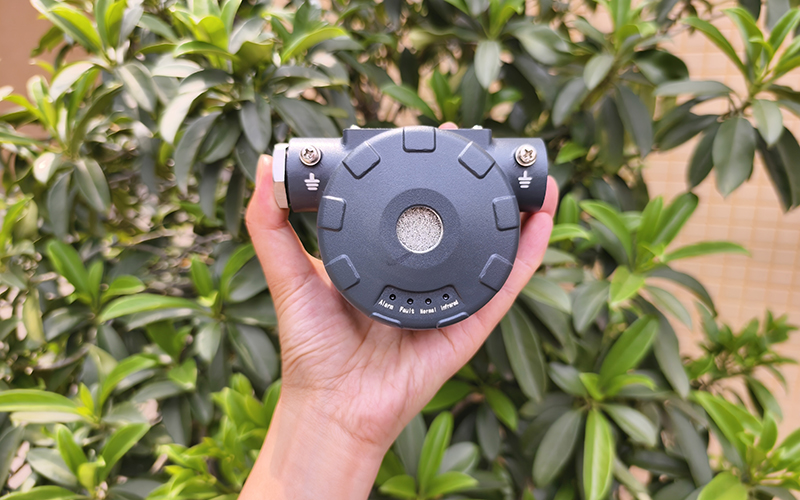
The CGT-H2100 is a long-life, maintenance-free hydrogen detection sensor adopting thermal conduction sensing technology and natural diffusion sampling mode, dedicated to 24/7 continuous hydrogen monitoring in energy storage scenarios. It supports detection ranging from 0 to 100% LEL, with a high resolution of 0.1% LEL and a detection error within ±5% LEL, ensuring precise early warning of hydrogen leakage in battery rooms.
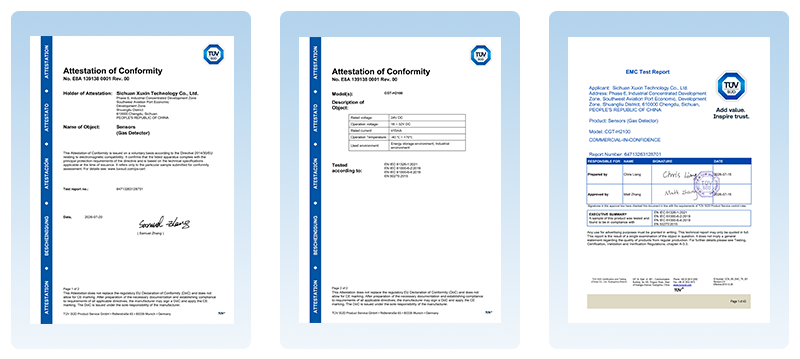
Featuring robust explosion-proof performance, it holds II 2 G Ex db IIC T6 Gb and II 2 D Ex tb IIIC T80℃ Db explosion-proof certificates, complying with mainstream international safety standards including IECEx, ATEX and CE. It adapts to Zone 1/2 hazardous gas and dust environments, fully meeting the stringent explosion-proof and fire safety requirements of Southeast Asian energy storage and fire protection projects. With an IP66 high-protection housing made of die-cast aluminum, it stably operates in -40℃ to +70℃ temperature and 5%–95% RH humidity environments, perfectly adapting to Southeast Asia’s tropical humid and dusty climatic conditions.
Feature of Gas Detection for Battery Storage Rooms
1) Ultra-long Service Life & Zero Daily Maintenance
Unlike conventional electrochemical sensors with short lifespans, the detector’s thermal conduction sensor boasts a 15-year service life in normal monitoring environments. It supports factory pre-calibration with no regular on-site calibration required, greatly reducing post-operation maintenance costs and downtime risks—an ideal solution for large-scale distributed energy storage projects in Southeast Asia with scattered sites and limited maintenance personnel.
2) High Adaptability to Harsh SEA Environments
The IP66 dustproof and waterproof structure effectively resists coastal dust, moisture and occasional splashing in Southeast Asian regions. It avoids zero drift and performance failure caused by high humidity, and its sealed housing prevents dust clogging of air inlets, ensuring stable and consistent detection accuracy in long-term outdoor and semi-outdoor energy storage cabin operation.
3) Flexible Networking & Compatible Fire Alarm System
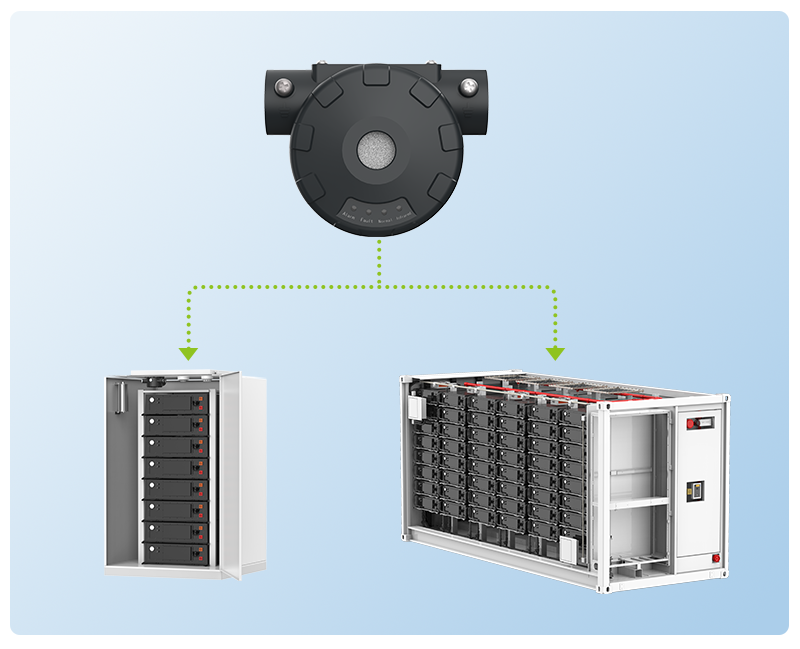
Equipped with standard RS485 communication (9600bps) and dual dry relay contacts for low/high alarm, it supports seamless connection with upper-level fire alarm hosts and BESS management systems. A single bus can network up to 32 detectors with hand-in-hand wiring, adapting to multi-module energy storage container layouts. Dual-stage alarm (10% LEL low alarm / 25% LEL high alarm) provides hierarchical early warning, helping teams quickly trigger ventilation and safety intervention to avoid explosion accidents.
4) High Safety & Full Compliance
Strictly designed for explosion-proof hazardous environments, it supports reliable grounding specifications with anti-static and anti-surge protection. It complies with IEC60079-1 explosion-proof standards and local Southeast Asian BESS fire safety regulations, helping projects pass safety inspections and certification efficiently.
Detail photos of Gas Detection for Battery Storage Rooms
Product parameters of Gas Detection for Battery Storage Rooms
| Type | Specific parameters |
| Appearance parameter | |
| Pigment | dark grey |
| Shell material | die-casting aluminium |
| Outline dimension | approximately 100 mm × 78 mm × 53 mm |
| Product weight | approximately 415 g |
| Function parameter | |
| Test gas | CO(carbon monoxide) |
| Sensor type | electrochemical sensor |
| Sample mode | natural diffusion |
| Detection range | (0~2000)×10-6 (volume fraction) |
| Operate mode | continuous monitoring |
| Alarm value setting range (Two-level alarm) |
The minimum alarm threshold for production output is set at 200×10-6 (volume fraction). The maximum alarm threshold for the outlet concentration is set at 500×10-6 (volume fraction). |
| Alarm error | ±50×10-6 (volume fraction) |
| Range indication deviation | allowable error: ±80×10-6 (volume fraction) |
| Alarming light visibility | > 5 m (in darkness) |
| Response time | ≤ 30s |
| Call time | ≤ 15s |
| Resolution ratio | 1×10⁻⁶ (volume fraction) |
| Zero drift range | ≤50×10-6 (volume fraction) |
| Sensor service life | normal monitoring environment for 15 years |
| Electrical parameters | |
| Working voltage | 18VDC-32VDC |
| Rated voltage | 24VDC |
| Power dissipation | ≤ 1W |
| Working current | ≤ 5 mA |
| Alarm current | ≤ 25mA |
| Maximum current | ≤ 25mA |
| Output signal | RS485 (optional) [The communication address defaults to 1 at factory; a built-in 120Ω matching resistor is not connected by default and can be enabled using a jumper cap] |
| Baud rate | 9600 bps |
| Dry contact 1 – Low alarm relay | Group 1: Contact capacity (resistance load): 1A @30VDC; 300 mA @ 125VAC. Factory default: Open during normal operation, close during alarms, open during power loss. |
| Dry contact 2 – High alarm relay | Group 1: Contact capacity (resistance load): 1A @30VDC; 300 mA @ 125VAC. Factory default: Open during normal operation, close during alarms, open during power loss. |
| Indicate way | |
| Pilot lamp | 3 LED status lights |
| State indication | 1. During normal operation: The green indicator light remains illuminated continuously |
| 2. In case of a malfunction: The yellow indicator light remains constantly illuminated. | |
| 3. Alarm indication: When the lower limit is exceeded, a red light flashes; when the upper limit is exceeded, the red light remains on continuously. | |
| 4. During the upgrade process: Red, yellow, and green lights will flash alternately. | |
| Upgrade and configuration parameters | Can be connected to a computer via the RS485 bus (optional) |
| Certification and protection level | |
| Attestation | ROHS, CE ,ATEx, IECEx |
| Protect grade | IP66 |
| Explosion-proof mark |
II2 G Ex db IIC T6 Gb II2 D Ex tb IIIC T80°C Db |
FAQ about Gas Detection for Battery Storage Rooms
Q1: Is the detector suitable for Southeast Asia’s high-humidity coastal energy storage scenarios?
A1: Yes. It works stably in 5%–95% RH wide humidity range with excellent anti-moisture and anti-corrosion performance. The fully sealed IP66 structure prevents internal condensation and dust accumulation, solving common failure problems of ordinary detectors in tropical humid environments.
Q2: Does it require frequent calibration and daily maintenance?
A2: No. The product features factory fixed calibration and maintenance-free operation. It only needs regular surface dust cleaning to keep air inlets unobstructed. After reaching the nominal service life, it can continue operating via annual accuracy testing, greatly saving operational costs.
Q3: Can it be networked with existing BESS and fire alarm systems?
A3: Absolutely. Standard RS485 communication and dual dry-contact alarm outputs match most mainstream fire hosts and BESS management devices. Adjustable 120Ω terminal resistance adapts to different on-site wiring lengths, supporting flexible networking for small cabin and large-scale energy storage station projects.
Q4: What safety certifications does it have for local project acceptance?
A4: It is certified with CE, IECEx, ATEX and RoHS, fully meeting international and Southeast Asian regional energy storage fire safety access standards, supporting smooth project inspection and acceptance.
Q5: How to avoid detection deviation in complex gas environments?
A5: The thermal conduction sensor is optimized for battery room hydrogen monitoring. It avoids cross-interference from conventional organic volatiles and trace alkaline gases, ensuring accurate and stable hydrogen concentration detection in actual BESS operating environments.